


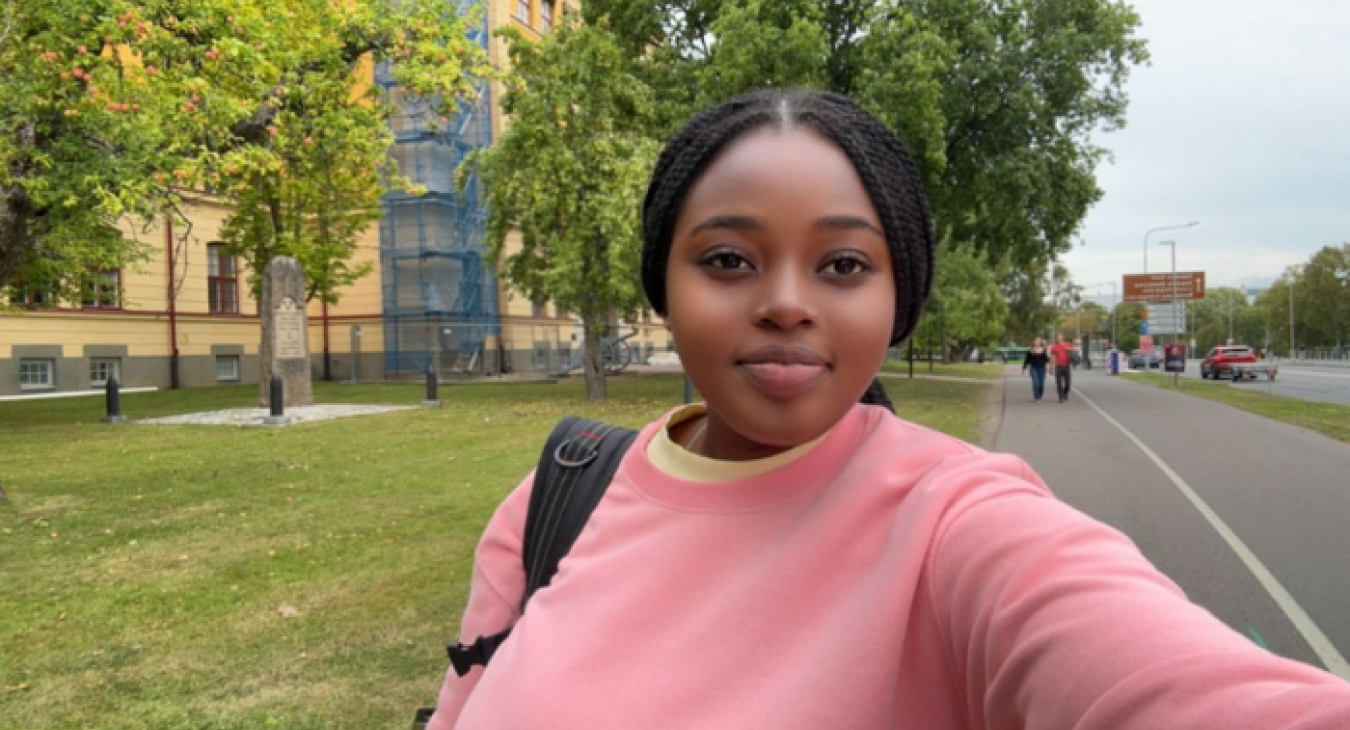
Building a career in academia once sounded to me like a simple process: read, pass your examinations, write your thesis and eventually earn your degree. As I continue through my PhD journey, however, I am beginning to understand that scholarship is much bigger than the degree itself. It is about learning to communicate your ideas, engaging with people outside your immediate academic circle, listening to different perspectives and finding the confidence to make your thoughts heard.
This is something I have had to learn along the way. Coming from an academic environment where students are often expected to listen carefully, respond when called upon and respect established ways of doing things, I have realised that listening is only one part of scholarly growth. Engagement matters too. You have to ask questions, share your thinking, receive criticism and sometimes allow others to challenge ideas you have spent months developing.
My visit to Uppsala has given me another opportunity to experience that side of academic life.
This is my second time in Sweden as a PhD student, but the experience feels very different from my first visit. The first time came with a sense of uncertainty and excitement about what to expect. I remember writing about how the experience almost sent a “shock to my spine.” This time, there is a greater sense of familiarity. I know the environment a little better, I understand what to expect, and I can focus more on the academic opportunities around me.
One of the things I continue to value most is the opportunity to engage directly with my supervisor, Prof. Soorej Jose Puthoopparambil. There is something different about sitting across from someone and discussing your research in person. Sometimes, he simply picks up a paper and a pen and begins to explain an idea. Those moments may seem ordinary, but they are difficult to replicate through a screen. There are conversations that become clearer when you can draw something, point to a paragraph, ask a question immediately and work through an idea together.
The physical environment at Uppsala has also made these interactions easier. I came during the summer, when many staff and students are away on break, so the university is quieter than usual. Yet, the quietness has its own advantage. Having an office space and being able to walk for less than a minute to speak with Silja, Samaha or Soorej has created opportunities for small but meaningful conversations.
Sometimes, these conversations are about research. At other times, they are about the practical challenges that come with being a PhD student. Even asking how to reduce a manuscript of more than 9,000 words to 6,000 words can become an academic conversation. What should stay? What needs to go? Which argument is essential? Which paragraph is repeating something already said? These may sound like small questions, but they are part of learning how to communicate research clearly.
My engagement with the Cluster of Research Excellence in Migration & Health (CoRE) has also been an important part of the experience. Conversations with the CoRE coordinator, Kajsa Hallberg Adu, have allowed me to discuss my research from another perspective and think about how my work on forced displacement, gender, health and WASH connects with wider conversations on migration and health.
This opportunity is also connected to the support and scholarly environment created through the IDRC Research Chair on Forced Displacement in Anglophone West Africa, under which I am a PhD scholar. Being part of the Chair has provided opportunities to develop my research, engage with other scholars working on forced displacement and participate in academic spaces beyond my immediate university environment. Experiences such as this visit to Uppsala remind me that the value of a research programme is also found in the networks, mentorship and exposure it creates for emerging scholars.
Beyond the office and research discussions, Uppsala itself has been part of the learning experience. A visit to the museum and other places around the city offered a different kind of reflection. There is something about seeing history preserved, documented and presented in a way that allows people to encounter it across generations. It reminded me that research and scholarship are also about understanding where ideas, institutions and societies come from. History cannot simply be forgotten because the present feels more important.
I have also come to appreciate the value of the ordinary moments. Walking around the university, meeting people, having short conversations between meetings and simply being in an environment where research is part of everyday life have all contributed to the experience. Not every important lesson comes from a formal seminar or a scheduled meeting.
Perhaps that is what I am learning most from this stage of my PhD: the PhD is not the whole story.
The degree matters, of course. The thesis matters. Publications, conferences, seminars and academic milestones matter. But there is another part of the journey that is harder to measure. It is learning how to engage. It is becoming comfortable with questions. It is learning to explain your ideas to people who may not immediately understand them. It is listening to criticism without taking it personally and being willing to change your thinking when the evidence requires it.
My time in Uppsala has given me space to reflect on that.
And yes, summer in Uppsala is indeed an experience. But beyond the weather, the walks and the beautiful surroundings, I am leaving with something more valuable: conversations, questions, new perspectives and a renewed understanding that becoming a scholar is about much more than completing a PhD.
- Log in to post comments