

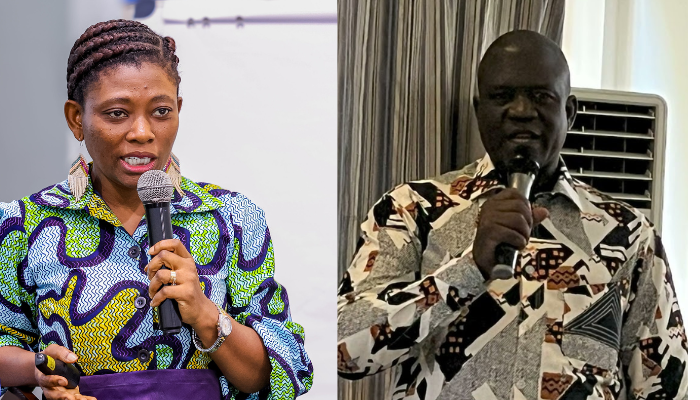

The IDRC Research Chairs on Forced Displacement in Anglophone and Francophone West Africa have shared updates on the progress of their respective projects, highlighting research, policy engagement, capacity building and collaboration during a meeting of the IDRC Research Chairs Network on Forced Displacement in Morocco.
Prof. Mary Boatemaa Setrana, IDRC Research Chair on Forced Displacement in Anglophone West Africa, and Dr Tiga Alain Ouedraogo, IDRC Research Chair on Forced Displacement in Francophone West Africa, presented the updates during the Network’s meeting in Rabat on 2 June 2026 as part of efforts to promote networking and knowledge sharing among the Research Chairs.
The meeting provided an opportunity for the Chairs to share experiences from project implementation, receive feedback from their peers and learn from approaches being used in other contexts to strengthen implementation and improve project outcomes.
Anglophone West Africa Chair
Prof. Setrana, who is also Director of the Centre for Migration Studies at the University of Ghana, presented the progress of the Anglophone West Africa project.
The project has made progress in research across Ghana, Nigeria, Sierra Leone and Liberia. It conducted 511 surveys in Ghana, 500 in Nigeria, 500 in Sierra Leone and 531 in Liberia. It also conducted 40 qualitative interviews in each of the four countries through key informant interviews and focus group discussions.
The project has also expanded its regional engagement through activities including a 2025 webinar on gender, climate change and forced displacement in West Africa, and engagements in 2026 on migration research, policy and practice and the realities of free movement in West Africa.
At the national level, the Anglophone West Africa Chair has supported policy dialogues on gender, climate change and forced displacement in Ghana; displacement, health challenges and protection measures in Liberia; and gender equality among internally displaced persons and refugees in Sierra Leone.
The project has also invested in training and capacity building. It established an annual Summer School on Forced Displacement for postgraduate students and early-career scholars and has trained 65 early-career researchers and PhD scholars since 2024 in collaboration with the African Union and Uppsala University. The project has also supported the training and supervision of two postdoctoral fellows, four PhD candidates and two MPhil students.
In policy support, the Anglophone West Africa Chair has contributed to the review of the ECOWAS Training Manual on Border Management for West African immigration officials and organised a mentorship workshop in Accra that trained more than 50 female officers from the Ghana Immigration Service, Police Service, Fire Service and Prisons Service on gender, leadership, migration and forced displacement.
The project has also contributed to policy development through work on Ghana’s National Migration Policy, the Migration Policy Framework for the African Union, gender-responsive guidelines for labour migration policies, action plans on trafficking in Ghana, the ECOWAS Manual on Border Management and the Community Engagement and Policing strategy in Ghana.
The presentation identified research fatigue among displaced communities, language and translation difficulties, political sensitivities, changing government priorities and institutional coordination as some of the challenges affecting implementation.
Going forward, the Anglophone West Africa Chair plans to strengthen participatory evidence generation with displaced communities, develop a West Africa Forced Displacement Data Dashboard, use regional policy platforms to communicate research findings, strengthen cross-border learning and produce policy briefs aligned with national priorities in Ghana, Nigeria, Liberia and Sierra Leone.
Francophone West Africa Chair
Dr Ouedraogo presented progress from the Francophone West Africa project, which is based in Burkina Faso.
The update included the completion of qualitative interviews in Burkina Faso as part of the research programme.
The Francophone West Africa project also contributes to broader regional efforts to connect researchers working on forced displacement across countries affected by displacement and insecurity. The presentation highlighted the establishment of a regional “One Student, One Teacher-Researcher” network in Korhogo, Côte d’Ivoire, linking academics from Côte d’Ivoire, Mali, Niger and Burkina Faso to support internally displaced students. It also highlighted the Three Borders Network in Tillabéri, Niger, which connects researchers from Mali, Niger and Burkina Faso to promote multidisciplinary collaboration on forced displacement in fragile cross-border areas.
Collaboration across the two Chairs
The two West African Chairs have also used the Network to strengthen collaboration and knowledge exchange between Anglophone and Francophone researchers.
As part of the Anglophone West Africa Chair’s capacity-building activities, four researchers from Burkina Faso participated in the MAPS programme, creating an opportunity for researchers from the two project contexts to engage in multi-perspective research on migration and forced displacement across the sub-region.
The collaboration reflects the cross-border nature of forced displacement in West Africa, where displacement and its drivers extend across linguistic and national boundaries. The engagement between the two Chairs provides opportunities to compare research experiences, share approaches and strengthen regional responses to displacement.
The joint progress update therefore provided more than a report on activities. It created a space for the Anglophone and Francophone West Africa Chairs to learn from each other, receive feedback from fellow Research Chairs and consider how lessons from project implementation could be applied to strengthen research, policy engagement and project outcomes.
The exchange forms part of the wider role of the IDRC Research Chairs Network on Forced Displacement in promoting collaboration, peer learning and knowledge sharing among researchers working on forced displacement across the Global South.
- Log in to post comments