

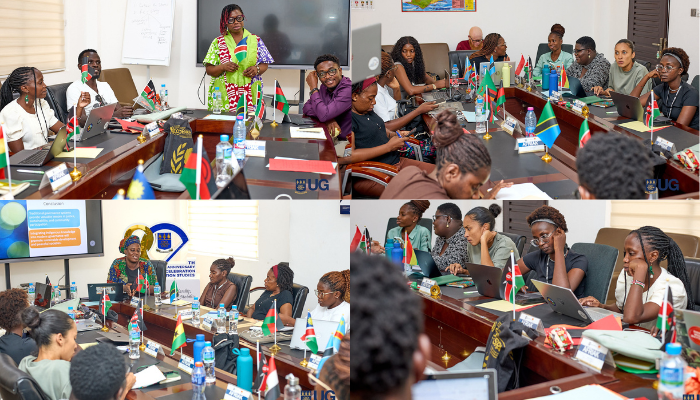

The IDRC Research Chair on Forced Displacement in Anglophone West Africa, led by Professor Mary B. Setrana at the Centre for Migration Studies (CMS), University of Ghana, hosted a cohort of African researchers and scholars for a month-long intellectual residency in March 2026 under the African Fellowships for Research in Indigenous and Alternative Knowledges (AFRIAK) programme.
Professor Setrana is Director of the Centre for Migration Studies and serves as the IDRC Research Chair on Forced Displacement in Anglophone West Africa, leading a multi-country project focused on strengthening knowledge and generating policy-relevant evidence on forced displacement across Ghana, Nigeria, Sierra Leone and Liberia. She is also a member of the Scientific Committee of the Council for the Development of Social Science Research in Africa (CODESRIA).
The residency, held at the University of Ghana Intellectual Hub, brought together researchers from across Africa for lectures, seminars, mentorship sessions, research discussions and engagements with faculty members, scholars, resource persons and Indigenous knowledge keepers. The programme was supported by CODESRIA under its AFRIAK initiative, which is implemented in partnership with the Mastercard Foundation.
AFRIAK, which stands for African Fellowships for Research in Indigenous and Alternative Knowledges, seeks to strengthen African research and knowledge production by supporting young researchers to work alongside academic mentors and Indigenous knowledge keepers. The programme places emphasis on Indigenous, local and endogenous knowledge systems that are embedded in communities and closely connected to lived experiences.
The month-long residency formed part of the wider AFRIAK fellowship, which includes research, training, mentorship, fieldwork and a residency at an intellectual hub. The intellectual hubs serve as spaces for research training, mentorship, convening and the co-creation of Indigenous knowledge among fellows, academics and knowledge holders.
The University of Ghana residency provided an opportunity to connect conversations on Indigenous and alternative knowledge with questions surrounding forced displacement. Discussions during the programme considered the importance of incorporating local experiences, community knowledge and Indigenous perspectives into research on displacement, migration and community resilience.
The engagement also highlighted the need for research on forced displacement to pay greater attention to the knowledge and experiences of affected communities. Participants explored how communities develop and draw on their own systems of knowledge, practices and coping mechanisms in responding to displacement and other forms of social disruption.
These discussions complemented the work of the IDRC Research Chair, which focuses on generating evidence and strengthening research capacity around forced displacement in Anglophone West Africa. The Chair’s work spans Ghana, Nigeria, Sierra Leone and Liberia and seeks to contribute to policy-relevant knowledge on the experiences and challenges associated with forced displacement.
The residency brought together 14 AFRIAK fellows from different parts of the continent. They included Marwan Mahmoud Hamdoun of Fayuom University, Egypt; Kelebogile Motlhabane of the University of Botswana; Dr Daizy Shoma Nalwamba of the University of the Free State, South Africa; Carina Tenewaa Kanbi of the University of Witwatersrand; Monica Francis Kapinga of the University of Dodoma, Tanzania; Maureen Njuhi Kuria of the University of Nairobi, Kenya; Dawn Chemoiwa of the University of Western Cape; Dr Chimwemwe Phiri of the Malawi School of Government; Chisomo Basikolo of LUANR, Malawi; Lavenda Odhiambo of Eco-Loop, Kenya; Clarina Mabuku Museta of the University of Namibia; Serak Shatimwene Oshouli Shidhudhu of MEIYSAC, Namibia; Kingasia Mamati of the British Institute in Eastern Africa, Kenya; and Richard Posite Vithundwa from the Democratic Republic of Congo.
The fellows were supported by faculty members and resource persons who contributed to the intellectual programme. They included Professor Yaw Agyeman Boafo, Professor Enoch Teye-Kwadjo, Dr Araba A. S. Osei-Tutu and Dr Abdul Karim Hakib.
The programme also brought Indigenous knowledge keepers into the fellowship activities, including Reuben Kositse Setrana and Mamaga Ametor II. Their participation provided an opportunity for the fellows to engage directly with knowledge holders whose expertise is rooted in community practices, experiences and traditions.
Scholars associated with the University of Ghana Centre for Migration Studies also participated in the residency. They included Rev. Francis William Aubyn, Ms Stella Effah, Ms Gifty Sarkodie Amponsah and Ms Comfort Baidoo.
The programme was coordinated by Mr John Narh and Mr Emmanuel Yakass, with administrative support from Mrs Mary Baagyere, Administrator at CMS.
The diversity of participants and contributors created a cross-disciplinary and intergenerational learning environment, with researchers from different countries engaging with academics and Indigenous knowledge keepers. Beyond the formal sessions, the residency offered opportunities for participants to share research experiences, discuss methodological approaches and explore areas for collaboration.
A key emphasis throughout the programme was the relationship between knowledge and lived experience. Participants reflected on how communities often develop their own ways of understanding and responding to displacement, environmental change, conflict and other disruptions, and how such knowledge can complement formal academic approaches to research.
The discussions further drew attention to the importance of ethical and participatory approaches to knowledge production. Rather than treating Indigenous knowledge simply as information to be collected, the engagement encouraged researchers to consider knowledge holders and communities as active participants in the production and interpretation of knowledge.
For the IDRC Research Chair and CMS, hosting the residency strengthened the Centre’s role as a platform for research, knowledge exchange and capacity development on migration and forced displacement. It also provided an avenue for the University of Ghana to contribute to a wider continental conversation on how African knowledge systems can inform research and responses to contemporary challenges.
The month-long engagement also reflected CODESRIA’s broader objective under AFRIAK to create spaces where young African researchers can engage in multidisciplinary knowledge production alongside academics, activists, policy practitioners and Indigenous knowledge holders.
The residency concluded with reflections on the value of connecting academic research with Indigenous and community-based knowledge. It reinforced the importance of creating spaces where researchers, scholars and knowledge keepers can work together to produce knowledge grounded in African realities and responsive to the experiences of communities affected by displacement and other social challenges.
- Log in to post comments